How much does a barbell weigh?
Standard Olympic barbell
A standard men's barbell weighs 20 kg, about 45 lb. A women's barbell weighs 15 kg, about 33 lb. Competition bar and collars together weigh 25 kg.
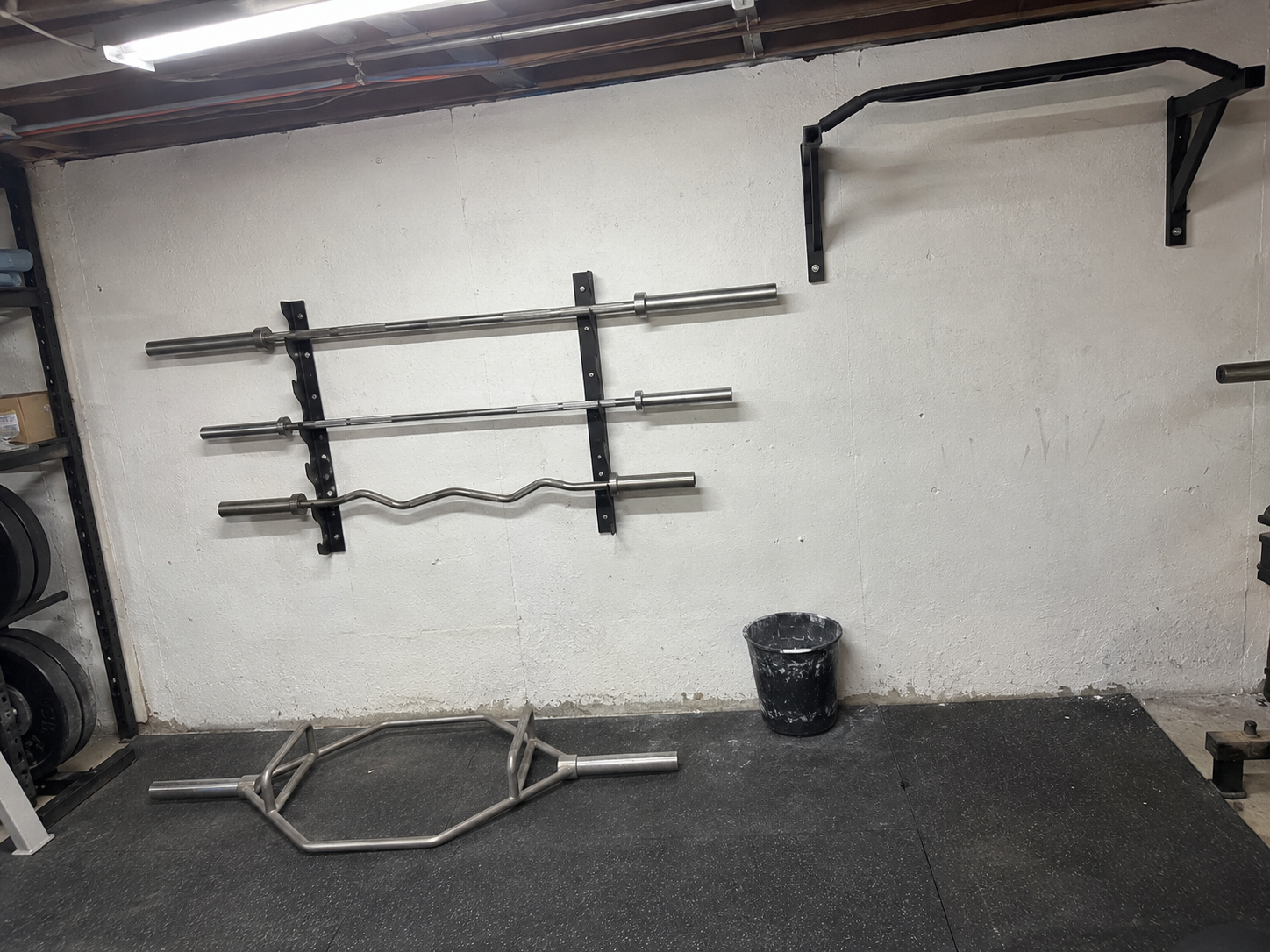
Common bar weights
| Bar | kg | lb |
|---|---|---|
| Olympic men's bar | 20 | 44.09 |
| Olympic women's bar | 15 | 33.07 |
| IPF competition bar | 20 | 44.09 |
| IPF bar and collars | 25 | 55.12 |
| EZ curl bar | Varies | Varies |
| Trap bar | Varies | Varies |
Barbell weight calculator
Total on the bar
In kilograms
The short answer
A standard men’s barbell weighs 20 kg. In pounds that is 44.09, which is why it is sold and labelled as a 45 lb bar. A women’s bar weighs 15 kg, or 33.07 lb, and is sold as a 35 lb bar.
- Most gyms use the 20 kg or 45 lb bar for squats, bench presses and deadlifts.
- Competition rules set the bar and collars together at 25 kg.
- EZ bars and trap bars vary by brand, so check the label or weigh yours.
The tool above lets you pick a bar type and see its weight in both units. For a full total with plates, use the barbell weight calculator.
Bar types and weights
The Common bar weights table above lists each standard bar in kilograms and pounds. IPF collars weigh 2.5 kg each, so a pair is 5 kg (11.02 lb). The IPF rule counts the bar and collars together as 25 kg (55.12 lb). EZ bars and trap bars vary, so check the label.
A 45 lb bar is 20.41 kg, and a 35 lb bar is 15.88 kg. That is a small gap from 20 and 15 kg. It matters little in training but it does matter when you move between pound and kilogram logs.
The bench press bar
For most people, the bench press bar is the standard Olympic bar, so 20 kg or 45 lb.
In competition, the bar follows the federation’s rulebook. The IPF rule for a competition bar is the one in the table below. Bars in a commercial gym may not match that spec, so do not assume the bench bar at your gym is a competition bar.
If you are not sure, check the bar for a weight stamp on the sleeve or shaft, or ask the staff. If the bar has no label, weigh it on a scale. Bars from different makers can weigh different amounts.
Olympic bar weight
An Olympic bar takes plates with a large centre hole. The standard men’s Olympic bar is 20 kg and the women’s bar is 15 kg. In the IPF competition rules, the sleeve diameter is 50 to 52 mm and the plate hole is 52 to 53 mm.
The IPF competition bar
The IPF’s technical rules give a detailed bar specification. These are the lines that matter.
| Spec | Rule |
|---|---|
| Total length | Not more than 2.2 m |
| Distance between collar faces | 1.31 to 1.32 m |
| Shaft diameter | 28 to 29 mm |
| Sleeve diameter | 50 to 52 mm |
| Bar and collars together | 25 kg |
| Marks on the bar | Spaced 81 cm apart |
| Knurling at IPF championships | Not chromed |
Collars are always used and must weigh 2.5 kg each. That leaves 20 kg for the bar, which is arithmetic from the two rules and not a separate rule.
The same rules set the plates. The allowed denominations are 1.25, 2.5, 5, 10, 15, 20 and 25 kg. Plates must be within 0.25% or 10 g of their marked weight, and the largest is no more than 45 cm across.
Collars
Collars are the clips that hold plates on the bar. In competition, they are always required and weigh 2.5 kg each, so a pair adds 5 kg. That is why the rule counts the bar and collars together as 25 kg.
At home, collars range from light spring clips to heavy locking collars, and weights vary. If you want an exact total, weigh your collars and enter them as a custom value in the barbell weight calculator.
USAPL and the 45 lb bar
A 45 lb bar is allowed at local USAPL meets. The IPF competition bar is specified in kilograms, as in the table above. If you plan to compete, check your federation’s rulebook for the bar used at your meet.
Women’s bars
A women’s Olympic bar is 15 kg, which is 33.07 lb, and is sold as a 35 lb bar. The 15 kg bar is common in weightlifting. The IPF rule text gives one weight, 25 kg, for the bar and collars together, so do not assume a women’s bar is used at a given meet. Check your federation’s rules.
For training, a lighter bar makes a difference at low loads. For a total, enter 15 kg or 35 lb as your bar in the barbell weight calculator, and the math adjusts.
EZ curl bar weight
An EZ curl bar is a shorter bar with a bend that lets your wrists sit at an angle. It is used for curls and triceps work. The weight depends on the maker, the length and the build, and no standard weight applies across brands.
To find the weight of yours:
- Look for a stamp on the bar or the product page.
- If there is none, weigh the bar on a scale.
- Enter that weight as a custom bar in the barbell weight calculator.
Do not guess. A guess of a few pounds can throw off every total you log.
Trap bar weight
A trap bar, also called a hex bar, is a hexagonal frame you stand inside to lift. It is used for deadlifts and shrugs. The weight depends on the brand and the size, and no single number covers every trap bar.
To find the weight of yours:
- Look for a stamp on the frame or the product page.
- If there is none, weigh it on a scale.
- Enter that number as a custom bar in the barbell weight calculator.
Why bar weights differ
Bar weight depends on length, shaft build and sleeve build. That is why no single figure covers every EZ bar or trap bar.
Treat any weight you read online as a guide. The real number is on your bar or on its product page.
What this means for your lifts
The bar is part of every number you lift. A 135 lb squat is a 45 lb bar plus a 45 lb plate on each side, and a 225 lb bench is the bar plus two 45 lb plates on each side. If you change bars, the same plates give a different total. Log which bar you use, and use the same bar for tests of your max.
If you move between pounds and kilograms, remember that the two systems do not line up exactly. Use the barbell weight calculator and the plate calculator to see the total in both units.
How to check your own bar
If your bar has no label, you can weigh it. Stand on a scale with the bar, then without it, and subtract. Do it twice to be sure. Write the number down and enter it as a custom bar in the barbell weight calculator.
Do the same for collars if you use them. Small weights add up when you log lifts for months, so a few seconds on a scale is worth it.
Loaded totals with a standard bar
Here is what common plate setups add up to. For more combinations, use the barbell weight calculator.
| Bar and plates | Total in lb | Total in kg |
|---|---|---|
| 45 lb bar, one 45 per side | 135 | 61.23 |
| 45 lb bar, two 45s per side | 225 | 102.06 |
| 45 lb bar, three 45s per side | 315 | 142.88 |
| 45 lb bar, four 45s per side | 405 | 183.70 |
| 20 kg bar, 25 and 15 per side | 220.5 | 100 |
| 20 kg bar, 25, 25 and 10 per side | 308.6 | 140 |
Questions
How much does a standard barbell weigh?
A standard men's Olympic barbell weighs 20 kg, which is 44.09 lb. It is sold as a 45 lb bar. A women's Olympic bar weighs 15 kg, which is 33.07 lb, and is sold as a 35 lb bar.
How much does a bench press bar weigh?
In most gyms, the bench press bar is the standard Olympic bar, so 20 kg or 45 lb. Some gyms have other bars, so check the label. For a competition bench, use the rulebook of your federation.
How much does an Olympic barbell weigh in kg and lb?
The men's Olympic bar is 20 kg, or 44.09 lb, usually sold as 45 lb. The women's is 15 kg, or 33.07 lb, usually sold as 35 lb. If a bar has a weight on its label, trust the label over any general figure.
How much does an EZ curl bar weigh?
It varies by brand, length and build, so there is no single answer. Check the label or the product page, or weigh it on a scale. Once you know the number, enter it as a custom bar in the barbell weight calculator.
How much does a trap bar weigh?
It varies by brand and size, so there is no single answer. Look for a weight on the frame or the product page, or weigh it on a scale. Enter that number as a custom bar in the barbell weight calculator.
Do collars add weight to the bar?
Yes, a little. IPF competition collars weigh 2.5 kg each and are always used, so a competition bar and collars together weigh 25 kg. Collars used in a home gym vary, so weigh yours if the exact total matters.
Is a women's barbell lighter?
Yes. A women's Olympic bar is 15 kg, or 33.07 lb, against 20 kg for a men's bar. The 15 kg bar is common in weightlifting. The IPF bar rule gives one figure, 25 kg for bar and collars together, so check your own federation's rules.