Warm-up calculator
Enter your first working weight and your bar to get a ladder of warm-up sets, rounded to your plates, that ends close to your working weight.
Simple ladder to 225 lb
Simple ladder: our design, not a rule.
| Set | Weight | Reps | Of working | Plates per side |
|---|---|---|---|---|
| 1 | 90 lb | 5 | 40% | 10 x 2, 2.5 |
| 2 | 135 lb | 3 | 60% | 45 |
| 3 | 170 lb | 2 | 75% | 45, 10, 5, 2.5 |
| 4 | 190 lb | 1 | 85% | 45, 25, 2.5 |
| Working | 225 lb | Your reps | 100% | 45 x 2 |
* The closest load these plates can make. Add smaller plates for the exact weight.
Weights are rounded to your step, ties up, and never go below the bar. A set equal to an earlier one, or at or above your working weight, is dropped. Rest as long as you need before the working set.
Working weight 225 lb, bar 45 lb, rounded to 5 lb. Simple ladder: our design, not a rule.
Last reviewed
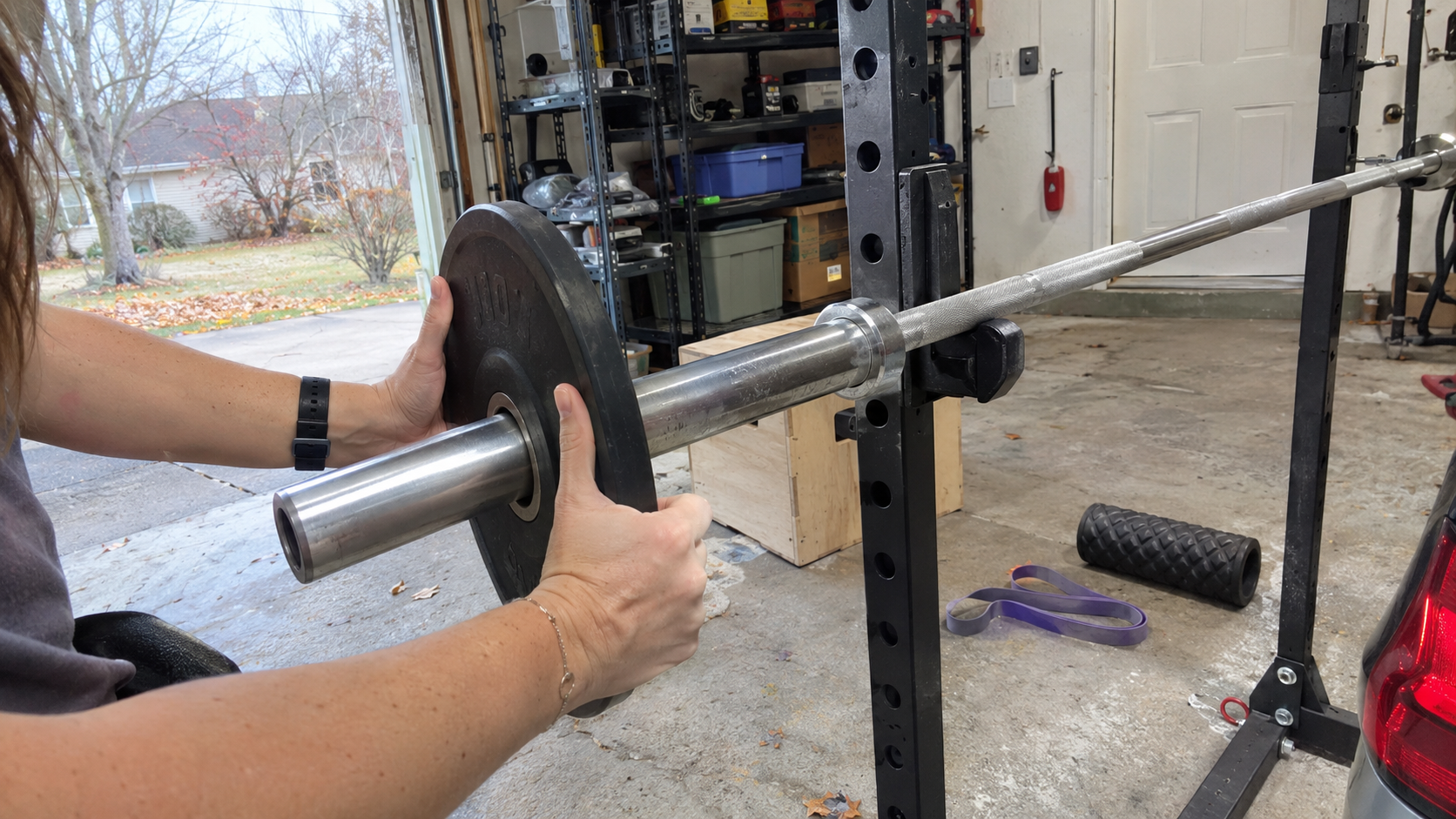
How the default ladder works
The default is a simple ladder. It is our design, not a rule. Four warm-up sets take you from light to near your working weight, and the rep count falls as the weight climbs.
| Set | Percent of working weight | Reps |
|---|---|---|
| 1 | 40% | 5 |
| 2 | 60% | 3 |
| 3 | 75% | 2 |
| 4 | 85% | 1 |
Each weight is rounded to your step, which is 5 lb by default or 2.5 kg. Halves round up. If a weight comes out below the bar, it is raised to the bar. Duplicate weights are dropped, and any set at or above your working weight is dropped too. If your working weight is the bar, there are no warm-up sets.
You can also pick your bar, from a 45 lb or 35 lb bar to a 20 kg or 15 kg bar, or enter a custom weight. The plates for each set are shown below the ladder.
Ladders for common working weights
These ladders come from the default settings: a 45 lb bar with a 5 lb step, or a 20 kg bar with a 2.5 kg step.
| Working weight | Warm-up sets |
|---|---|
| 135 lb | 55 x 5, 80 x 3, 100 x 2, 115 x 1 |
| 225 lb | 90 x 5, 135 x 3, 170 x 2, 190 x 1 |
| 315 lb | 125 x 5, 190 x 3, 235 x 2, 270 x 1 |
| 60 kg | 25 x 5, 35 x 3, 45 x 2, 50 x 1 |
| 100 kg | 40 x 5, 60 x 3, 75 x 2, 85 x 1 |
| 140 kg | 55 x 5, 85 x 3, 105 x 2, 120 x 1 |
For light working weights, the ladder shrinks. At 60 lb on a 45 lb bar, the tool gives 45 x 5 and 50 x 1.
Why warm up this way
A good warm-up has two parts. A general part raises your body temperature and gets you moving. A specific part uses the lift itself, with weights that build up to your working set.
The ladder covers the specific part. It ramps gradually, ends around 75 to 85% of the working weight, and keeps the heaviest sets to low reps so you stay fresh.
On the general side, one small study of 13 people found that 20 minutes on a stationary bike before the lifting warm-up raised leg press max by 8.4%. The lifting warm-up in that study was 8 reps at about 50% and 3 reps at about 70% of estimated max. It is one study on one exercise, so take it as a reason to move first, not as a formula.
No validated ladder exists for every lifter. That is why this page labels the default as a design choice. If your coach or program uses a different ramp, follow that instead.
Keep the setup the same on max days
If you are testing a max, warm up the same way each time and use the same equipment, bar and footwear. Changing the setup can change the number. For the full testing steps, see the guide on how to calculate one rep max.
Rest before the first heavy set
How long to rest before the first working set depends on you. One coach suggests about 6 minutes after the last warm-up before a first heavy set. That is one view. Others use shorter breaks. Start with enough rest that you feel fresh, then adjust to what works in your training.
Other warm-up ladders
Coaches use different ramps. This list shows two that people use. We build the default only, so the other presets are noted here for reference.
- One coach’s ladder: 30, 40, 50, 60, 70 and 80% of the working weight for 8, 6, 4, 2, 1 and 1 reps.
- A ten percent ramp: steps of about 10% of the working weight, with singles late in the ramp.
A longer ladder suits very heavy days and max attempts. A shorter one suits lighter work.
Warming up for a one rep max
A widely used outline for max testing builds like this:
- Start with 5 to 10 reps at a light weight, then rest 1 minute.
- Move to a weight you can lift for 3 to 5 reps, then rest 2 minutes.
- Move to a weight you can lift for 2 to 3 reps, then rest 2 to 4 minutes.
- Attempt a max, with smaller or larger jumps depending on how it felt.
Upper body lifts usually step up by 10 to 20 lb, or 5 to 10%. Lower body lifts step up by 30 to 40 lb, or 10 to 20%. If an attempt fails, rest 2 to 4 minutes and take a smaller jump.
Do not test a max if you are tired or unwell, and always use a spotter or safety bars.
Questions
How many warm-up sets should I do before heavy squats?
Four is a common number, and it is what the default ladder uses: 40% for 5, 60% for 3, 75% for 2 and 85% for 1, then your working set. A lighter lifter or a lighter day may need fewer. Coaches ramp in different ways, so treat four as a starting point.
How much should I warm up before my working set?
Ramp up gradually and finish near 75 to 85% of your first working weight, so the working set does not feel like a jump. Keep the last warm-up sets to low reps. They should prepare you without costing energy.
Should I rest before the first working set?
A longer rest after the last warm-up helps some lifters. One coach suggests about 6 minutes before a first heavy set. That is one view, not a rule, so rest long enough that the first heavy set feels as good as the warm-ups.
How do I warm up for a one rep max?
Use a ramp that gets heavier while reps fall. One widely used outline starts with 5 to 10 light reps, then 3 to 5 reps, then 2 to 3 reps, with rests of 1 to 4 minutes, before the first max attempt. The one rep max guide linked below covers the full steps.
Do I need a general warm-up as well?
It can help. In one small study of 13 people, a bike warm-up before the lifting warm-up raised leg press max by 8.4% over the lifting warm-up alone. It is one study and one exercise, so treat it as a hint, not a rule. A few minutes of easy movement is enough for most people.